






Loading cart contents...


Discover the 13 Essential Koi Varieties and How to Identify Them
Koi originated in China as ornamental fish, but it was the Japanese who refined them into the stunning varieties we see today. While some may consider them just colorful carp, koi come in over 100 distinct varieties, each with its own unique beauty. For judging purposes, the Japanese have categorized the koi varieties into 13 main classes. By exploring these classifications, you’ll gain a deeper appreciation for these elegant fish. You may even discover which types are swimming in your own pond!
Kohaku is the most popular koi variety in Japan, known for its pure white body—ideally as bright as possible—adorned with striking red markings. The pattern of these red markings varies, giving rise to different types of Kohaku. Ideally, the red should cover about half of the body, creating a balanced and visually appealing contrast.
 Kohaku
Taisho Sanke, commonly called Sanke, was the first tri-colored koi to be developed. It features a white base with bold red markings and evenly distributed black patterns. Unlike Showa, Sanke koi do not have black markings on their heads, maintaining a cleaner facial appearance.
 Taisho sanke
Showa Sanshoku, or Showa, also displays the three colors of red, white, and black, but its primary base color is black, overlaid with red and white markings. A key distinction of Showa koi is the presence of black markings on the head, further enhancing their striking appearance.
 Showa
Utsurimono, or Utsuri, consists of three distinct two-colored koi varieties. Shiro Utsuri features a striking black-and-white pattern, Hi Utsuri combines black with deep red, and Ki Utsuri showcases black with vibrant yellow. These koi have a black base color with contrasting red or yellow markings, and they typically display black markings on the head.
 Utsuri
Bekko is another bi-colored variety that resembles Utsurimono but differs in a key way—Bekko koi do not have black markings on the head. There are three types: Shiro Bekko (black and white), Aka Bekko (black and red), and Ki Bekko (black and yellow). Their clean, patterned appearance makes them a distinct choice among koi enthusiasts.
 Bekko
Hikarimuji, also known as Ogon, are single-colored koi with a striking metallic sheen. The most popular varieties include Platinum Ogon, known for its brilliant white shimmer, and Yamabuki Ogon, which features a vibrant yellow hue. Another notable type is Matsuba Ogon, which has black-centered scales that create a distinctive ‘pinecone’ effect. These koi are highly prized for their bright, reflective colors, making them stand out beautifully in a pond.
 Hikarimuji or Ogon
Asagi and Shusui are among the earliest fancy Japanese koi varieties, both recognized for their blue coloration. Asagi are fully scaled, non-metallic koi with a net-like blue pattern covering their backs and red coloration below, while their heads are typically white or gray. Shusui, on the other hand, are scaleless (doitsu) and have a similar color palette, with a few rows of enlarged scales running along the dorsal line, giving them a unique and striking appearance.
 Asagi
Koromo, meaning “robed,” is a koi class that includes varieties like Goshiki and Goromo. These koi are known for their delicate, lace-like overlays on the scales, typically featuring a white body with red markings enhanced by a striking net-like blue or black pattern, creating a unique and refined appearance.
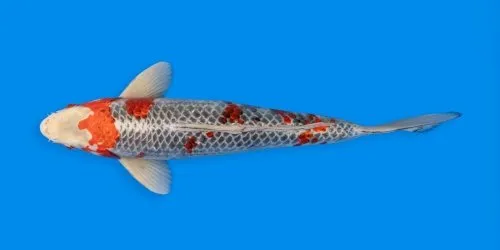 Goshiki (Koromo)
Tancho is a striking koi distinguished by its pure white body and a single, typically round red marking on its head. While various symmetrical red markings can occur, the perfectly circular shape is the most prized among enthusiasts.
 Tancho
Hikari Moyomono refers to metallic koi with more than one color, displaying a shimmering, reflective quality. Popular varieties in this category include Hariwake, Kujaku, Kikusui, and Kikokuryu, each offering a dazzling combination of hues and patterns.
 Hariwake (Hikari Moyomono)
Kin-Gin-Rin, often shortened to Gin-Rin, refers to koi with sparkling, reflective scales that create a shimmering effect in the water.
 Gin-rin Kohaku
Shusui closely resemble Asagi but are doitsu, meaning they lack traditional scales. Instead, they have a pale blue body with two rows of dark blue mirror scales running along the dorsal fin and a single row along the lateral line. Their heads are white, while the lower half of the body is typically red, creating a striking contrast.
Kawarimono is a diverse classification for non-metallic koi that do not fit into other established categories. This group includes both doitsu (scaleless) and gin-rin (sparkling-scaled) varieties. Common examples include Benigoi (solid orange), Kigoi (solid yellow), and Chagoi (brown variations), among others.
 Benigoi (Kawarimono)
While there are literally hundreds of koi varieties, the Japanese have developed this basic system of thirteen categories, with some sub-categories. Although classifying and identifying koi can be complex for the average pond owner, the most important factor in choosing koi is personal preference. Whether you’re drawn to specific colors, patterns, or metallic sheens, selecting koi that appeal to you is key. To ensure your koi thrive, always purchase from a reputable retailer or breeder to guarantee their health and well-being.
Related posts

Butterfly Koi: Basic Facts to Know
In certain circles, when you mention butterfly koi it’s like speaking out of turn in an audience with the Pope. You just don’t do this. Quite a few of the koi connoisseurs think of butterfly koi as

They Don’t All Have to Be Koi
It may seem like a novel concept, but not all the fish in your pond have to be koi. There are other pond fish out there that can bring joy and benefits to your water garden.

Discover the Colorful World of Pond Fish: Beyond Koi
Besides the colorful koi, an array of pond fish is just waiting to call your pond their home.